LearnLoop: reimagining the learning loop with AI
Abhishek Vulla on building LearnLoop, moving it into real classrooms and keeping students engaged with the source material.
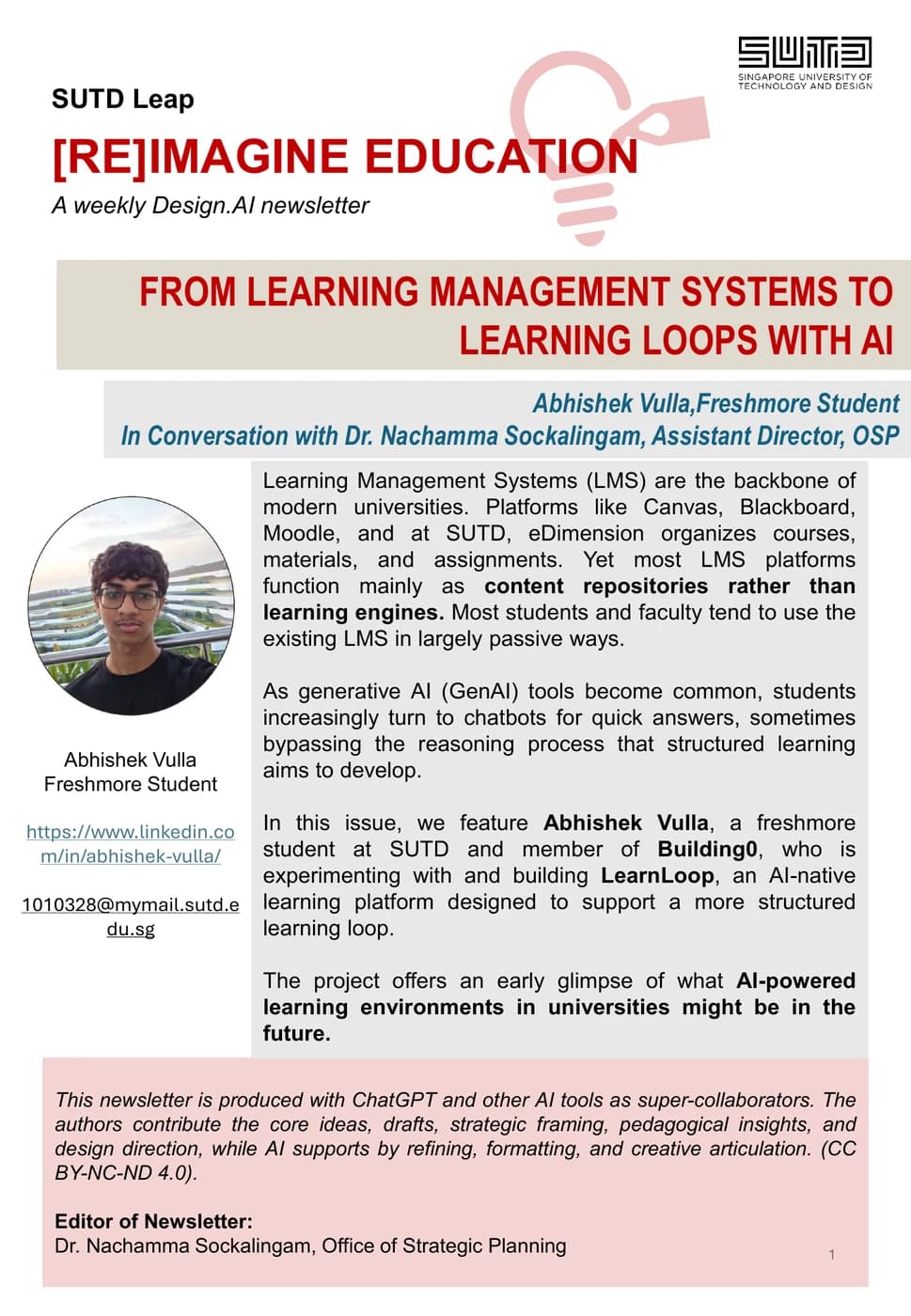
This is a readable web version of the LearnLoop feature prepared for the March 2026 SUTD Design.AI newsletter. The questions and answers have been lightly edited for the web. The original seven-page PDF is available above.
How did LearnLoop start?
I joined Building 0 in November 2025 because I wanted to be around people who were building, not just talking about ideas.
My first SUTD project was Deadline Centre, a Chrome extension that collects deadlines from eDimension and Gradescope. After I shipped it, a senior from Building 0 pushed me to look at the deeper problem. Deadlines were one symptom. Students were still digging through course folders, passively rereading PDFs and pasting questions into generic chatbots that could not show where an answer came from.
That became LearnLoop.
What does it do?
LearnLoop is an AI study layer built around course material. Students can search across their slides using semantic search, ask a tutor that stays grounded in those slides and submit photos of handwritten work for feedback.
The tutor does not need to be the source of truth. It keeps the relevant lecture slide beside the response so the student can check the answer. The grader looks for the step where the reasoning broke, then points back to the course material that explains it. Interactive simulations let students change a value and see the concept move.
The aim is simple: use AI to keep the student thinking, not to finish the thinking for them.
How was it built?
The retrieval pipeline converts course material into embeddings stored in PostgreSQL. Each search stays inside the current course boundary, and responses carry the source reference back to the interface.
Different parts of the product use different models. The tutor prioritises speed and course grounding. The handwritten grading flow needs stronger vision and reasoning. Interactive simulations use generated p5.js code to turn a concept into something the student can manipulate.
The rest of the system is a TypeScript web app with a backend API, PostgreSQL, authentication and object storage. It moved to Railway after the first hosting setup became unreliable under the grading workload.
What went wrong?
The first infrastructure choice worked for a prototype but struggled in normal use. Cold starts pushed tutor responses towards 30 seconds, memory limits crashed the grading path and long-running processes could disappear. Moving the system meant transferring 1,520 files, replacing parts of the deployment setup and checking that the course material survived the migration.
The harder mistake was product work. I kept adding features before enough students had used the previous version. Feedback from Building 0 changed the question from "what should I add next?" to "who can use this today?"
That shift led to a real classroom pilot. LearnLoop was later used with 40 students across two classrooms, and the institutional security review changed how course files, access and instructor control were handled.
What comes next?
LearnLoop is not trying to replace SUTD's learning platform. It adds a study layer around the material and workflow students already have.
The next useful test is not another feature. It is whether the tutor, grader and simulations help in a real course without getting in the lecturer's way.