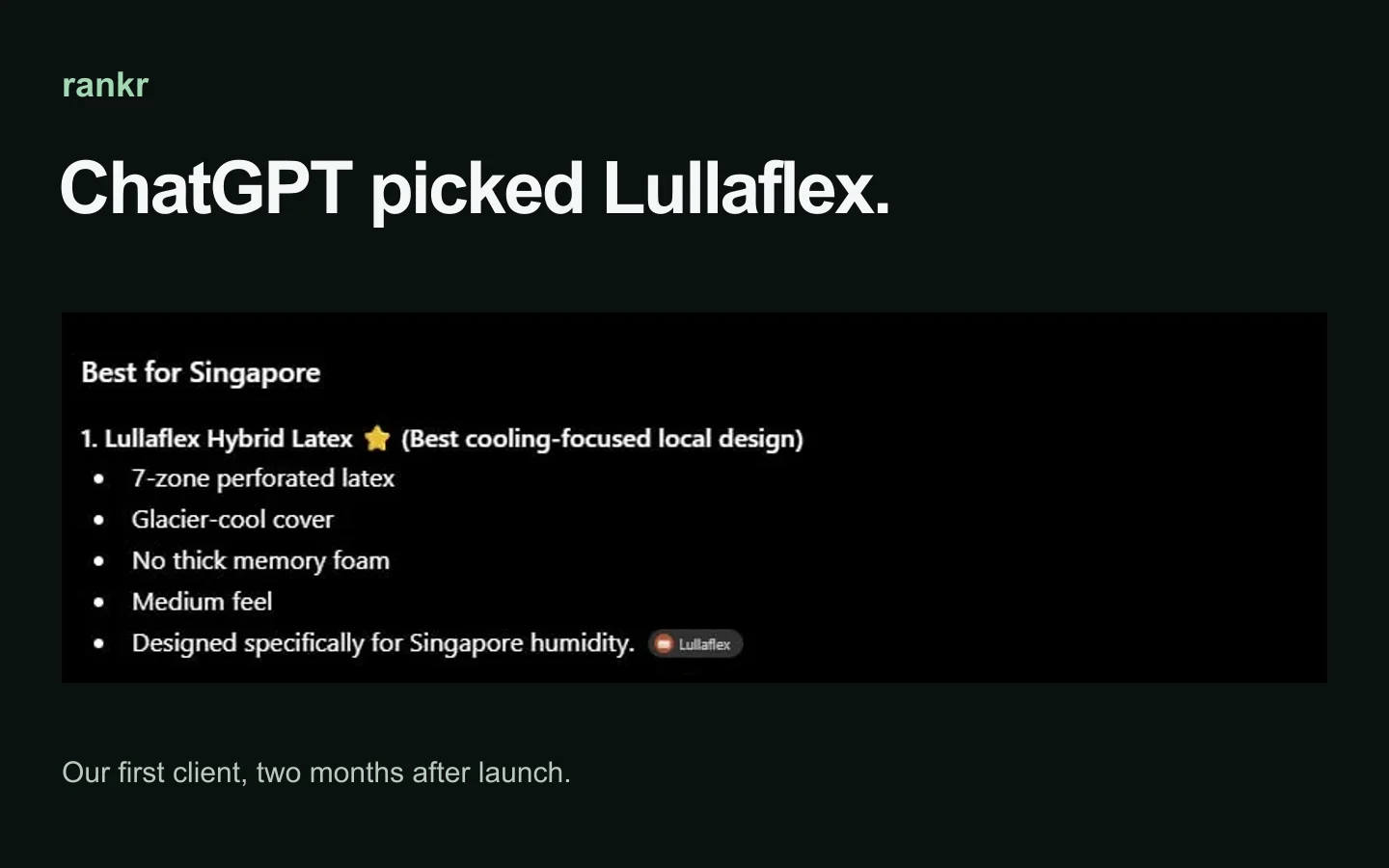
On 26 July 2026, ChatGPT recommended Lullaflex Hybrid Latex as "Best for Singapore" when asked for the best cooling mattress for hot weather. We had built the company's first website two months earlier, starting with no backlinks.
Another client, B&P Forum, had a different problem: Google was showing a test copy of its site alongside the real one.
At rankr, I work directly with clients and build the software and websites behind the service. That includes the content pipeline and Lullaflex's bedroom planner.
A mattress site and a bedroom planner
In May, I bought Lullaflex's domain and built the site from scratch. The product pages described what a buyer would need to choose a mattress: perforated latex, the cooling cover, dimensions and firmness. We linked them to guides on Singapore bed sizes and room clearance.
On 4 July, we launched the free Bedroom Layout Planner. Visitors could enter their room dimensions, move furniture at scale and switch between 2D and 3D. They could check whether a bed left enough room to open the wardrobe or walk past it.
We added guidance on measuring door swings, using the bed frame's dimensions rather than the mattress alone, and checking the delivery route through lifts and doorways.
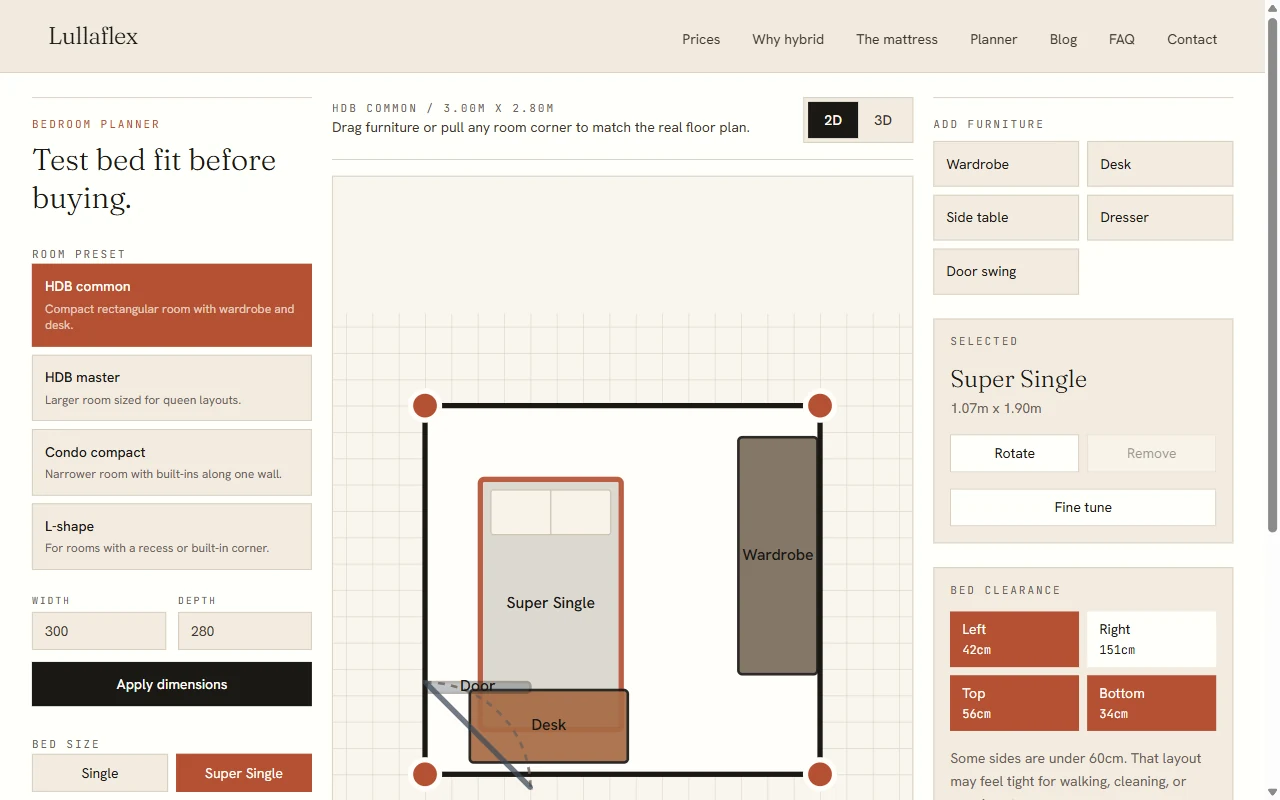
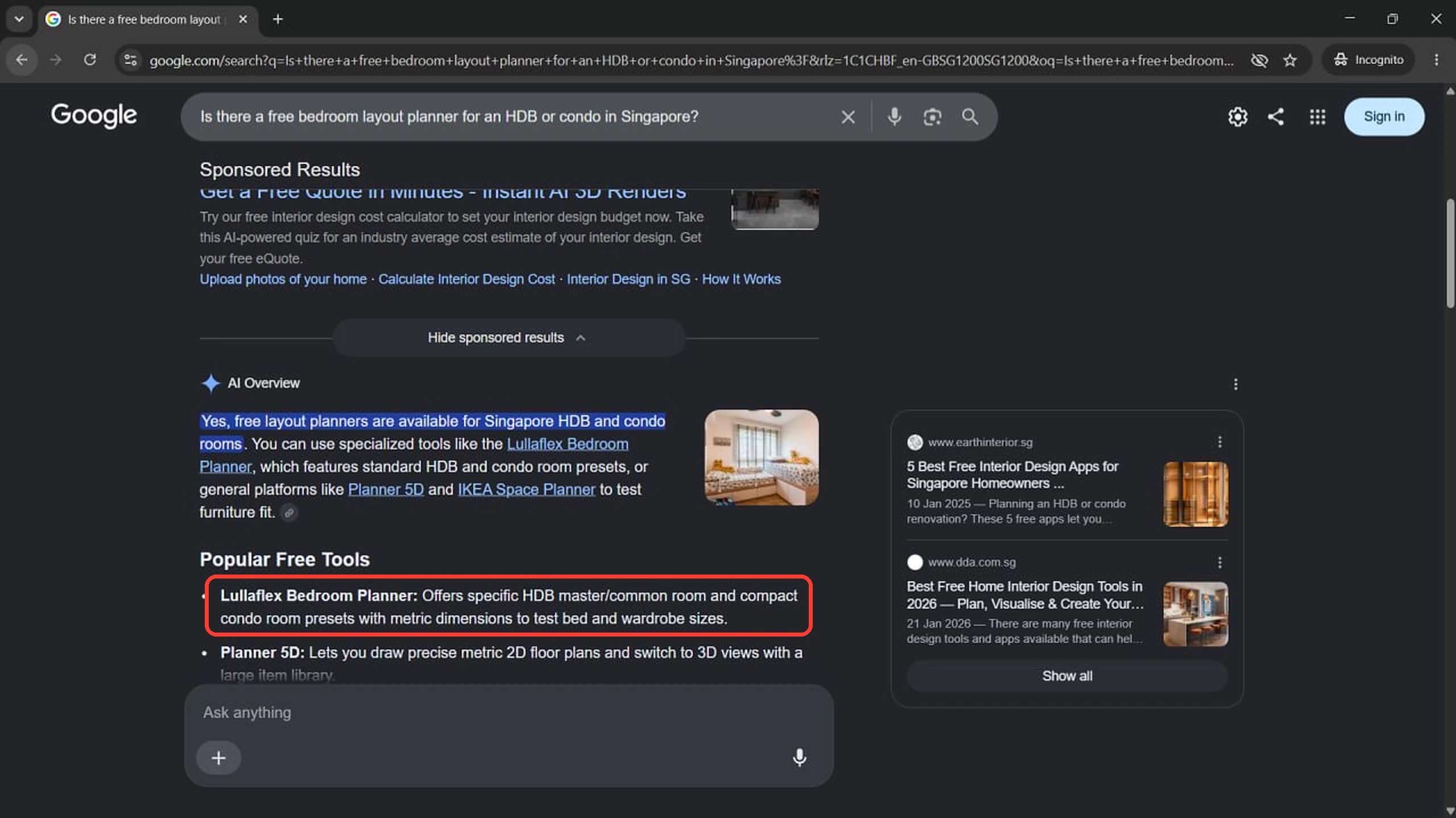
On 12 August, Google's AI Overview named the planner first in an incognito search for a free bedroom layout planner for an HDB or condo in Singapore. The planner article records the capture and the changes leading up to it.
Google clicks grew from 1 in June to 7 in July, 29 in August and 64 in September. The site only launched in late May, so some of that rise is a new site being found. The single-bed size guide received 2,559 impressions in September. The Lullaflex case study has the monthly breakdown.
Google's copy of B&P Forum was the wrong one
For the Business & Philanthropy Forum, the staging site collected 21,457 Google impressions in August, about 78% of the domain's total, with almost no clicks.
We blocked that copy and had it removed from Google. By September, it had no impressions. We also rewrote titles and descriptions for 83 English pages and published nine articles based on the forum's own speaker interviews.
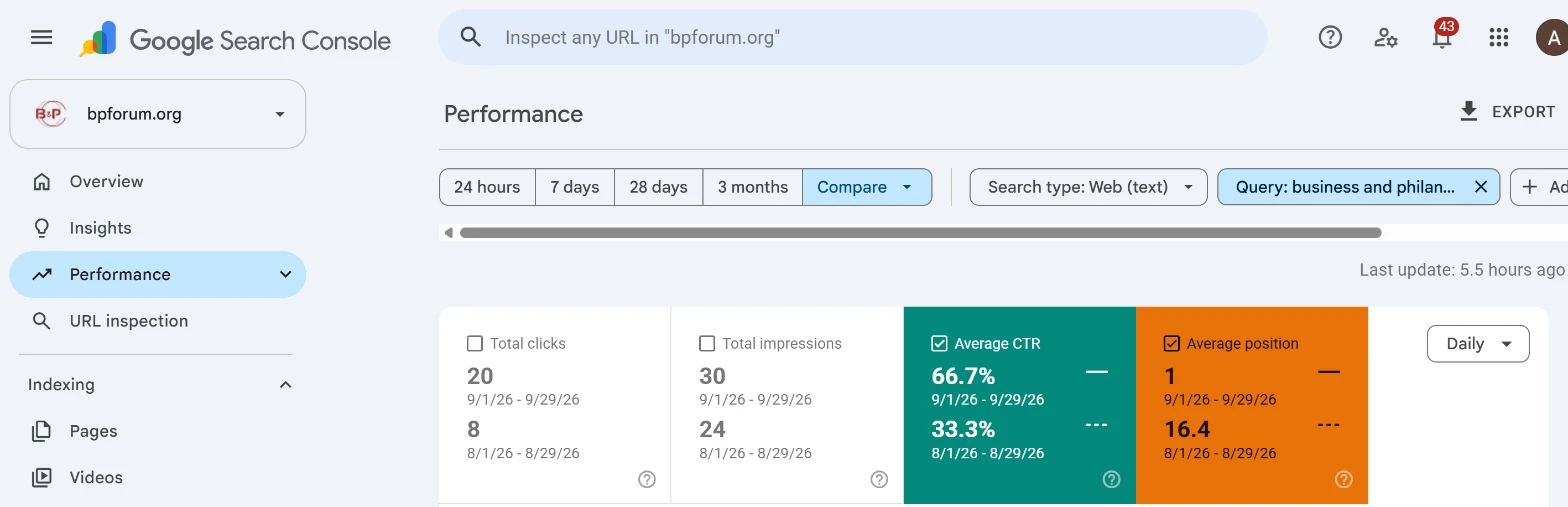
Comparing 1 to 29 August with 1 to 29 September, the average position for "business and philanthropy forum" improved from 16.4 to 1. Counted page by page, clicks to the real site rose from 211 to 279, a 32% increase.
Domain-wide click-through rate rose from 0.8% to 2.3%, largely because the staging site's low-click impressions left the count. That is separate from the real site's click growth. Several changes overlapped, and searches for the forum were already rising ahead of its event, so these figures do not isolate the effect of each change.
B&P Forum's new blog received 2,575 impressions in its first 23 days. Six of the seven articles with data averaged a first-page Google position within weeks of publication. The B&P Forum case study shows the queries, dates and counts.